The drive you don't get paid for
Every quote visit has the same shape. The customer rings and describes the job as best they can, and you book a time to go and look. You drive there, look for a bit, drive back, then price it that night. If they pick someone else, all of that was unpaid.
Some of those visits matter. You need to stand in the roof space, test something, or see how bad the rot really is. But plenty of them are a round trip across town to confirm what a few decent photos would have shown you: what's there now, what condition it's in, and how hard it is to get to.
That's the gap photo quoting fills. Not every job, and not instead of your judgement.
Customers have been sending photos for years
Tradies have always said "send us a photo". The trouble is what comes back. One blurry shot in a text, another a few days later in an email, no answers to the questions you actually needed, and a dark photo of a cupboard that could be anything. You end up ringing them anyway, and half the time you go out anyway.
So what's changed isn't the idea. It's that you can now ask for photos in a way that gets you usable ones:
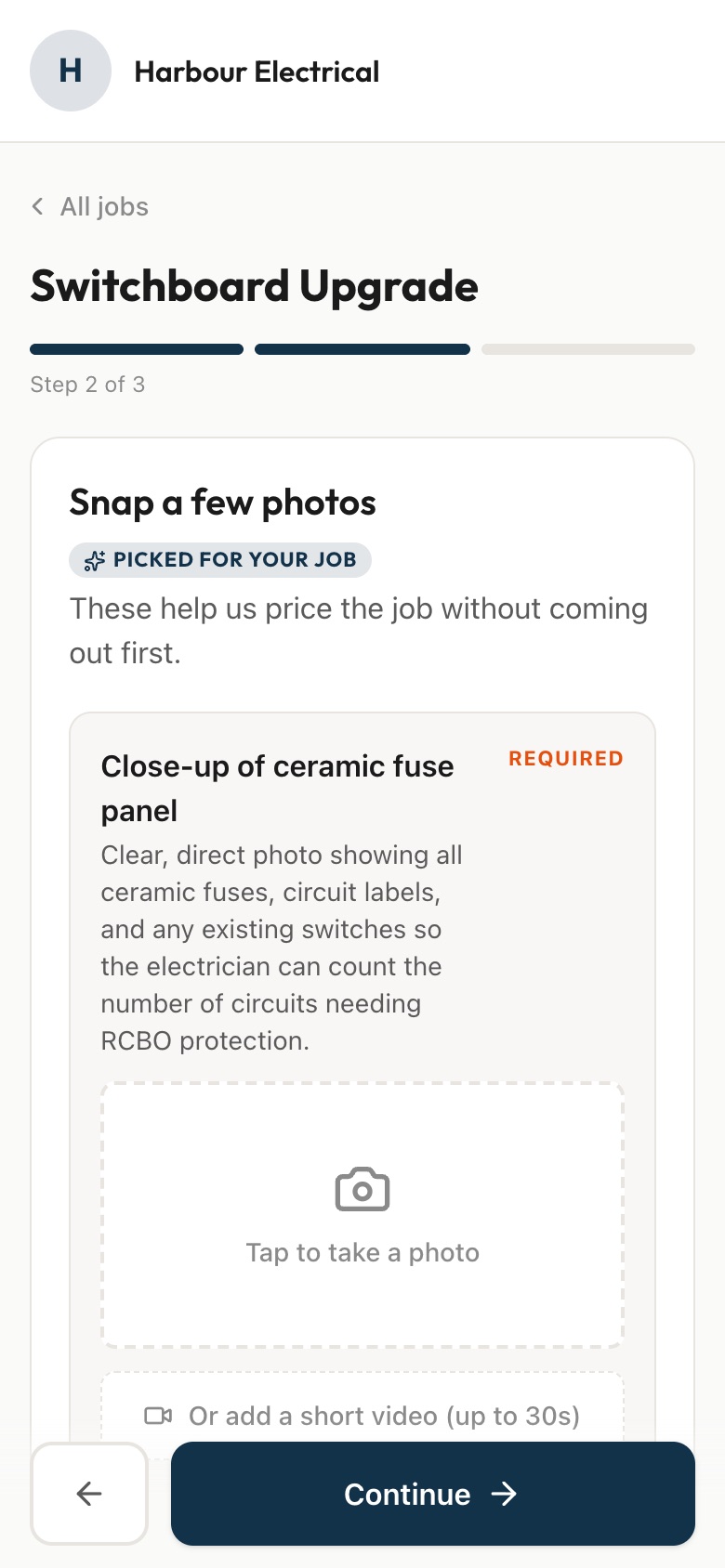
- The customer gets a list, not a vague request. "Photo of the switchboard with the door open" gets a better result than "send a pic of the board".
- Questions sit next to the photos. Tap-to-answer questions cover what a photo can't show, like how old the house is or whether the problem is getting worse.
- Bad photos get caught early. If a photo is blurry or too dark, the customer is asked to take it again while they're still standing there, not after you've opened it at home.
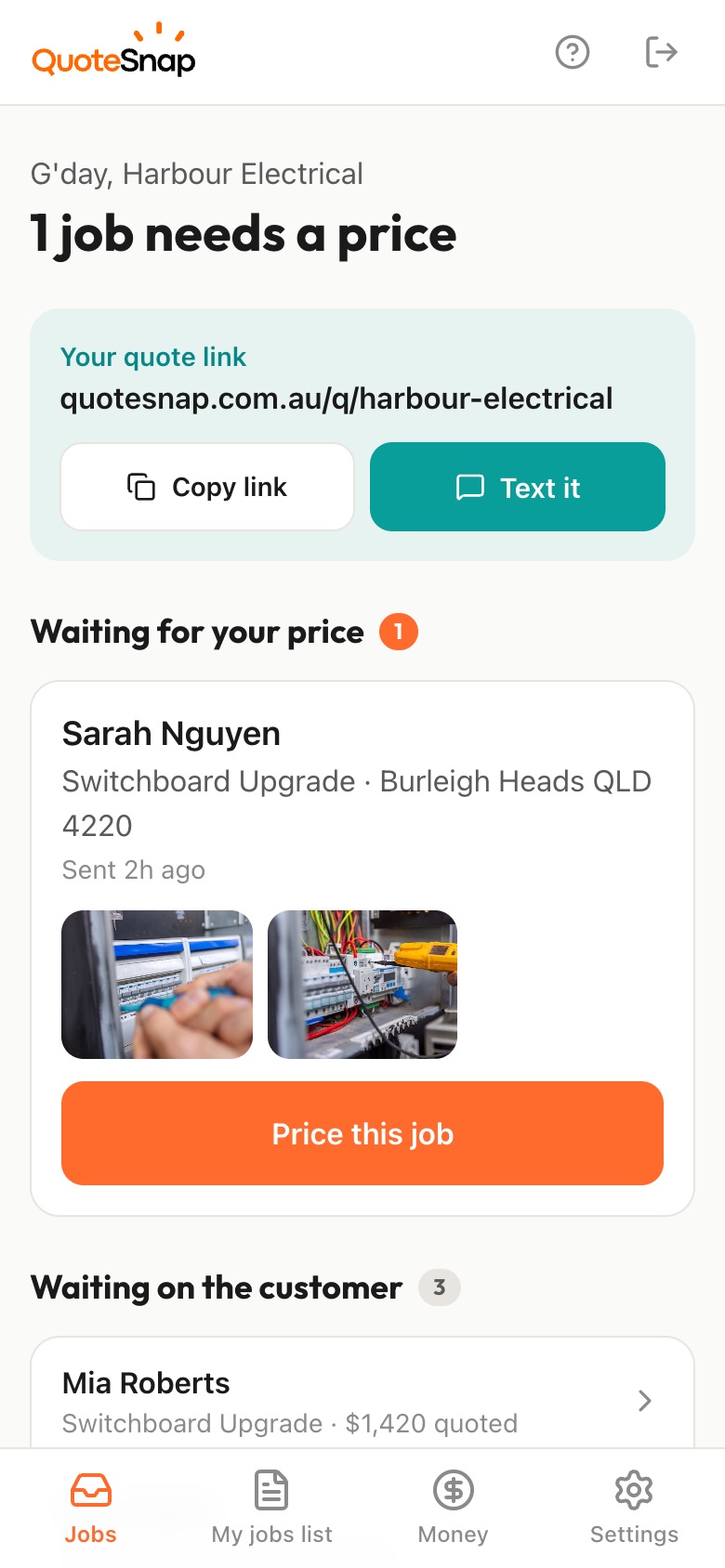
- It all lands in one place. Answers, photos and contact details together, not scattered across texts, emails and voicemail.
How it works in practice
Here's the process with QuoteSnap. It works the same way for any trade:
- You text or email a link. The customer opens it in their phone browser. There's nothing to download.
- They answer questions and take photos. Most questions are tap-to-answer, and the photo requests tell them exactly what to shoot. AI (artificial intelligence) checks each photo as it comes in and asks them to retake it if it's blurry, too dark, not of the job or looks like a stock image.
- The request lands with you. You get the answers, the photos and a short AI summary: what's in the photos, the condition, and anything to check, like access, safety or missing information.
- You decide. Price it from your phone, ask a follow-up question, or book a visit because the photos aren't enough. That call is always yours.
- You send the quote. By text or email, with a list of what's included. The customer opens it on the same link and signs to accept.
Which jobs suit photo quoting
The best fits are jobs where the scope is mostly visible and the variables are well known. A few by trade:
Electricians
Switchboard upgrades, extra power points, ceiling fans and EV (electric vehicle) chargers. A photo of the board with the door open, the meter box and the install location covers most of the first conversation. Anything you'd need to test or trace stays a visit. Photo quoting for electricians.
Plumbers
Hot water swaps, leaking taps, simple blocked drains and gas appliance connections. The data plate on the hot water unit and a photo under the sink do a lot of the work. Photo quoting for plumbers.
Painters
Interior and exterior repaints. Room-by-room photos plus a close-up of the worst wall show you the prep. Height and access show up in a wide shot of the house. Photo quoting for painters.
Roofers
Repairs and gutters, using photos taken from the ground or an upstairs window. They're good for sorting urgent from not urgent, and for knowing what to bring when you do go up. Photo quoting for roofers.
Air conditioning
For HVAC (heating, ventilation and air conditioning) technicians, back-to-back split system installs are a strong fit. The wall, the outdoor spot and the existing unit tell you most of what you need. Photo quoting for HVAC technicians.
Builders
Decks, fences and pergolas, at least to a first price or a range. Bigger renovations usually still need a meeting on site, but photos mean you turn up already knowing the scope. Photo quoting for builders.
"But I need to measure it"
Fair enough, for some jobs. But it's worth separating the quote from the job.
For a lot of work, the price depends on scope, condition and access, not on an exact figure. You need to know it's a mixer tap with no isolation valve, not the exact pipe size. You need to know it's three bedrooms with patched walls and a high ceiling in the hallway, not the square metres to the decimal.
Where a measurement does drive the price, ask for it. "Roughly how long is the fence line?" works fine as a question, and you can word your quote around it.
If the number really has to be exact before you can commit, that's a visit, and that's fine.
When you still need to go and look
Photo quoting cuts out the visits that were only about looking. It doesn't cut out the ones where you need to be there. Keep visiting when:
The difference is that you arrive informed. You've seen the photos, you know what to bring, and the visit is about confirming, not discovering.
Why customers go along with it
The fair worry is whether customers will bother. Look at it from their side. A visit means waiting for a time that suits you, being home for it, then waiting again for the quote. A link means they can do it tonight, from the couch, in their own time.
Most people are glad to skip having someone walk through the house just to look.
For what to ask for in each trade, see what photos to ask customers for before you quote.
Getting started
QuoteSnap has ready-made forms for electricians, plumbers, builders, HVAC technicians, roofers and painters. For any other job, type the job name and AI writes the questions and photo requests, then you check and edit them. Every form can be changed to suit how you work.
It's 7 days free, then $4.99 a month for Basic or $8.99 a month for Premium, with unlimited quote requests. See pricing.
The short version
- Ask for each photo by name, with questions next to them
- Get bad photos retaken before you sit down to price
- Read labels and data plates yourself
- Ask for measurements as questions and word the quote around them
- Visit for anything structural, unsafe, hidden or needing testing
- When you do visit, arrive informed
Free download
"Photos or visit?" checklist
A quick checklist for deciding when photos are enough.
We'll send the odd quoting tip. Unsubscribe any time.
Send your next quote link today.
Pick a form for your trade, copy your link, and send it to your next enquiry. 7 days free. Cancel any time.
Start free trial